The Surprising Truth About Color Blindness and Human Vision
When most people hear the term “color blindness,” they picture a world drained of color—everything in shades of gray, like an old black-and-white film.
The surprising truth is far more intriguing: true black-and-white vision is extremely rare. Most people with color blindness see colors—just not the same range or intensity as those with normal vision. They live in a different, often less vibrant, version of our colorful world.
Let’s explore the science behind color vision, the different types of color blindness, and what the world really looks like to someone who has it.
How Normal Color Vision Works
Your ability to see millions of colors comes from three types of cone cells in the retina:
- L-cones — sensitive to long wavelengths (reds and oranges)
- M-cones — sensitive to medium wavelengths (greens and yellows)
- S-cones — sensitive to short wavelengths (blues and violets)
People with normal vision are trichromats—all three cone types function properly. The brain compares the signals from these cones and constructs the rich, full-color experience we take for granted.
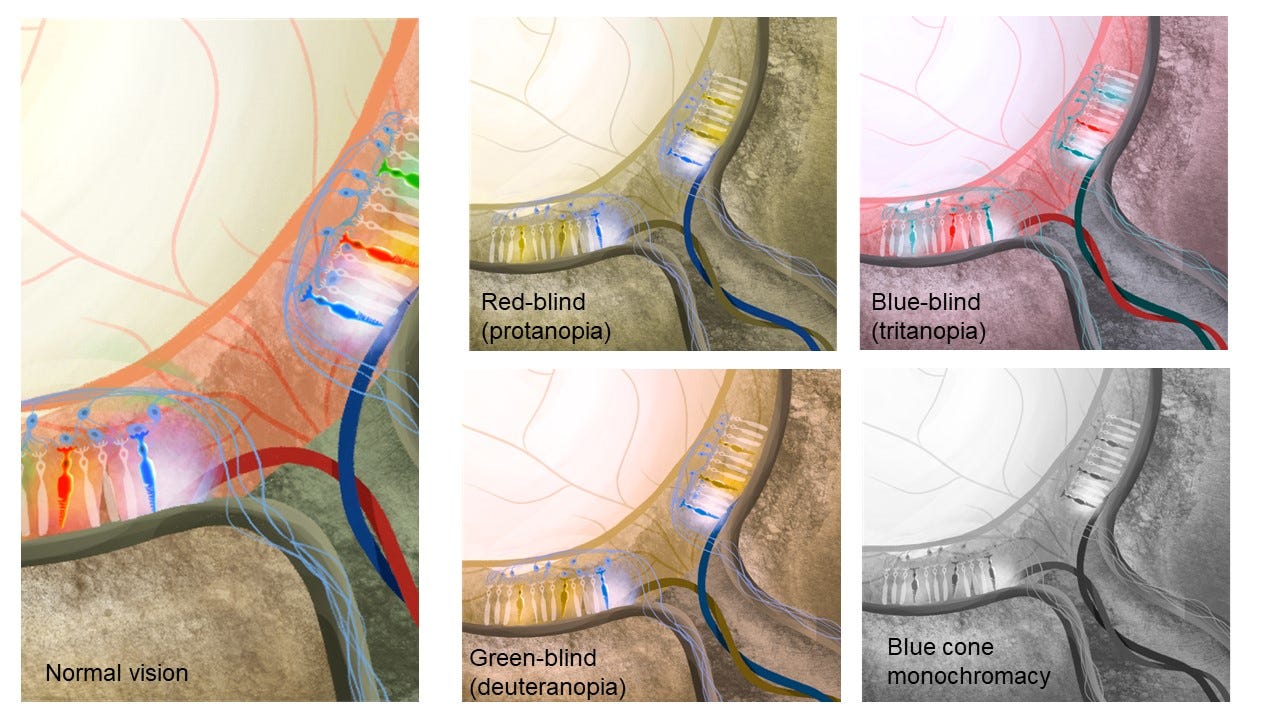
Caption: Normal trichromatic vision relies on three types of cone cells. Color blindness occurs when one or more cone types are missing or faulty.
The Surprising Types of Color Blindness
Color blindness (more accurately called color vision deficiency) exists on a spectrum. Here are the main types:
- Red-Green Color Blindness (by far the most common)
- Deuteranomaly (green-weak): Most common, affecting about 6% of men.
- Protanomaly (red-weak): Affects about 1% of men.
- Protanopia / Deuteranopia: Complete absence of red or green cones.
- Blue-Yellow Color Blindness (much rarer)
- Tritanomaly / Tritanopia: Problems with blue cones. Affects men and women equally (~0.01%).
- Complete Color Blindness (Monochromacy)
- Extremely rare. Only shades of gray are visible, often with poor vision and light sensitivity.
Important fact: Color blindness affects roughly 8% of men and only 0.5% of women because the genes responsible for the red and green cones are carried on the X chromosome.
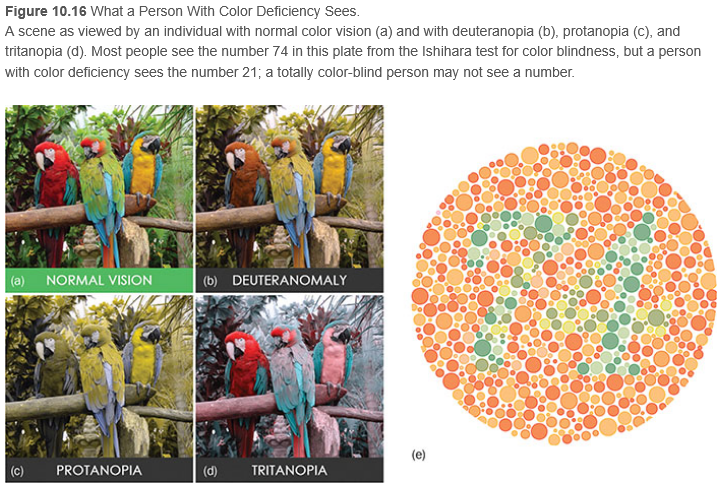
Caption: Side-by-side simulation: Normal vision (a) compared to deuteranomaly (b), protanopia (c), and tritanopia (d). Most color-blind people do not see in black and white.
What the World Really Looks Like
People with red-green color blindness don’t live in a grayscale world. Instead:
- Reds, greens, oranges, and browns often look similar — frequently muted shades of beige, yellow-brown, or gray.
- Bright reds may appear dull or brownish.
- Purple can look like blue.
- Pink sometimes appears gray or light blue.
- Blues and yellows are usually still vivid and distinguishable.
Many describe their vision as “duller” or “washed out,” especially in the red-green range. However, they often become very skilled at using brightness, texture, and context to distinguish objects.
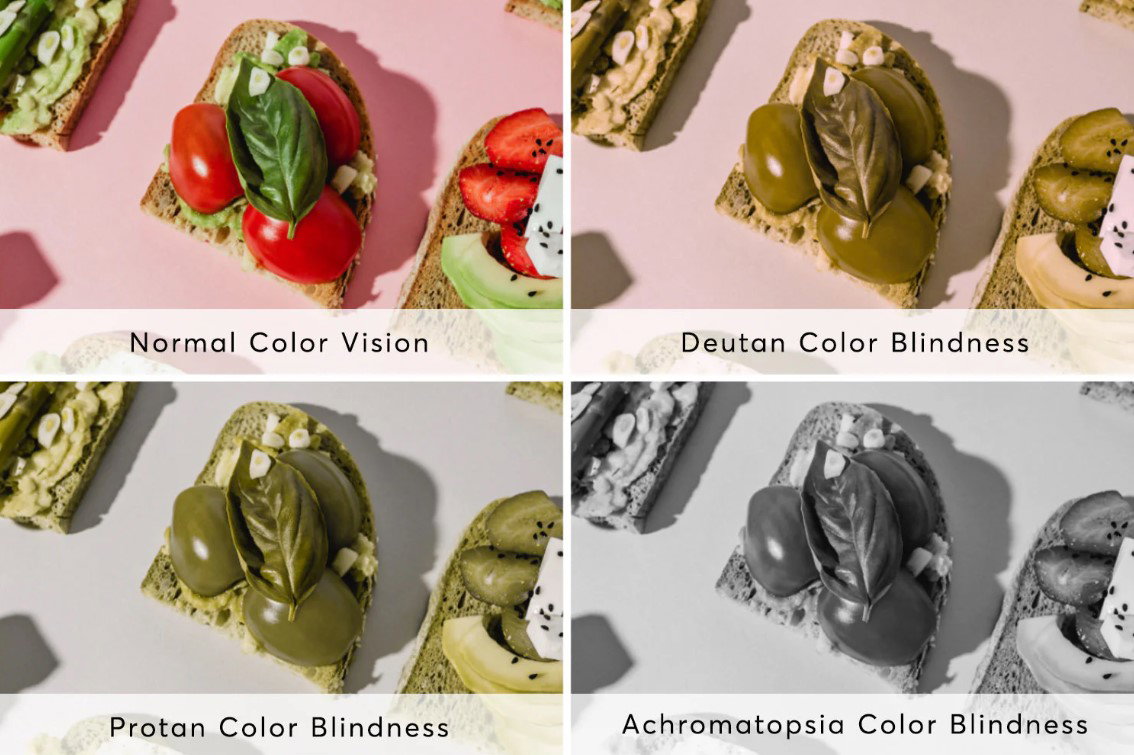
Caption: Realistic simulation of everyday food under normal vision versus different types of color blindness.
How Color Blindness Is Tested
The classic test uses Ishihara plates — circles filled with colored dots that hide numbers. People with normal vision see one number, while those with red-green color blindness see a different number or none at all.
Modern digital tests and apps can simulate exactly what a color-blind person sees, helping designers create more inclusive visuals.
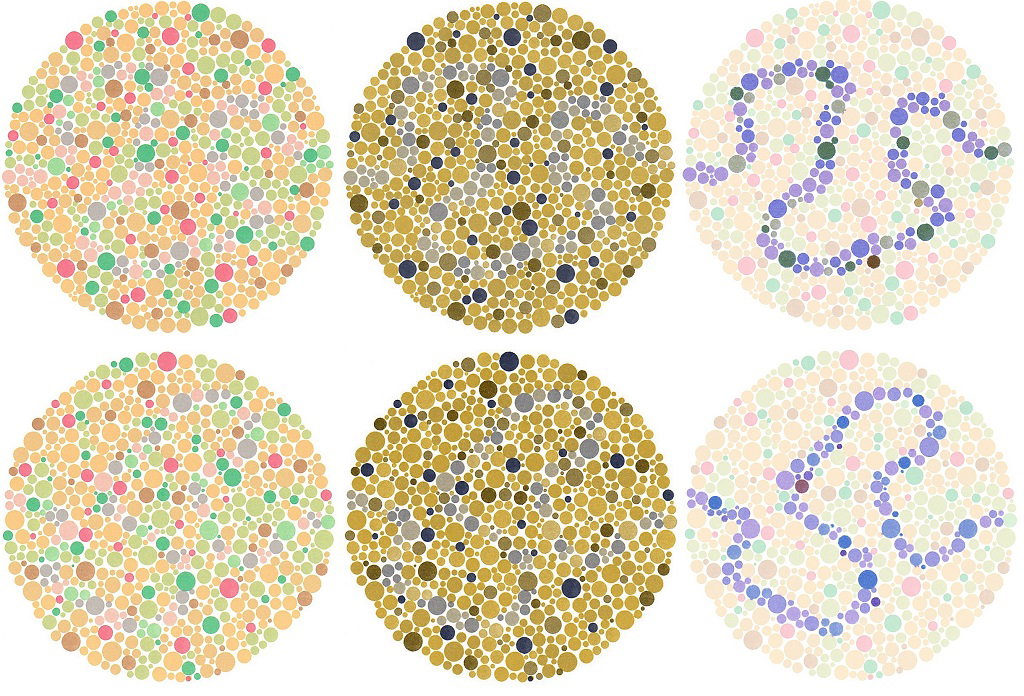
Caption: Ishihara test plates: What someone with normal vision sees versus what a person with red-green color blindness sees.
Living with Color Blindness
Color blindness doesn’t stop people from leading full lives. Many adapt brilliantly by learning cues beyond color (position of traffic lights, labels, and patterns).
Helpful modern tools include:
- Color-blind modes in apps and games
- Browser extensions that adjust colors
- Special glasses (like EnChroma) that can help some people with mild deficiencies see more distinction between reds and greens
Why Understanding Color Blindness Matters
Color blindness reminds us that color is not objective—it is a biological construction. Two people can look at the exact same object and genuinely perceive different realities.
This knowledge drives better design: using patterns and labels instead of color alone, creating accessible websites, maps, and interfaces, and fostering empathy for different ways of experiencing the world.
The next time you see someone struggling with a color-coded chart or traffic light, remember—their eyes aren’t broken. They’re simply wired differently, seeing a unique version of our colorful world.