Why Two People Can See the Same Color Differently
You and your friend look at the same sunset, the same shirt, or the same painting. One of you says “That’s a beautiful deep red,” while the other insists it’s more orange. Who’s right?The surprising answer is: both of you might be.Color is not an objective property fixed in the world. It is a subjective experience created inside your brain. Two people can look at exactly the same object under the same lighting and genuinely perceive different colors — and science now explains why.
The Biological Reason: Differences in Cone Cells
Human color vision starts with three types of cone cells in the retina:
- L-cones (long-wavelength, sensitive to red)
- M-cones (medium-wavelength, sensitive to green)
- S-cones (short-wavelength, sensitive to blue)
Most people are trichromats—they have all three cone types. However, small genetic variations mean the exact sensitivity of these cones differs slightly from person to person. The peak sensitivity of L-cones or M-cones can shift by a few nanometers, changing how the brain interprets mixtures of wavelengths.
Women are more likely to have subtle variations because they have two X chromosomes (the genes for L and M cones are on the X chromosome). In rare cases, some women are functional tetrachromats—they have four types of cones and can potentially see millions more colors than the average person.
Even among typical trichromats, individual differences in cone ratios, lens yellowing with age, or macular pigment density mean your “red” may not look exactly like my “red.”
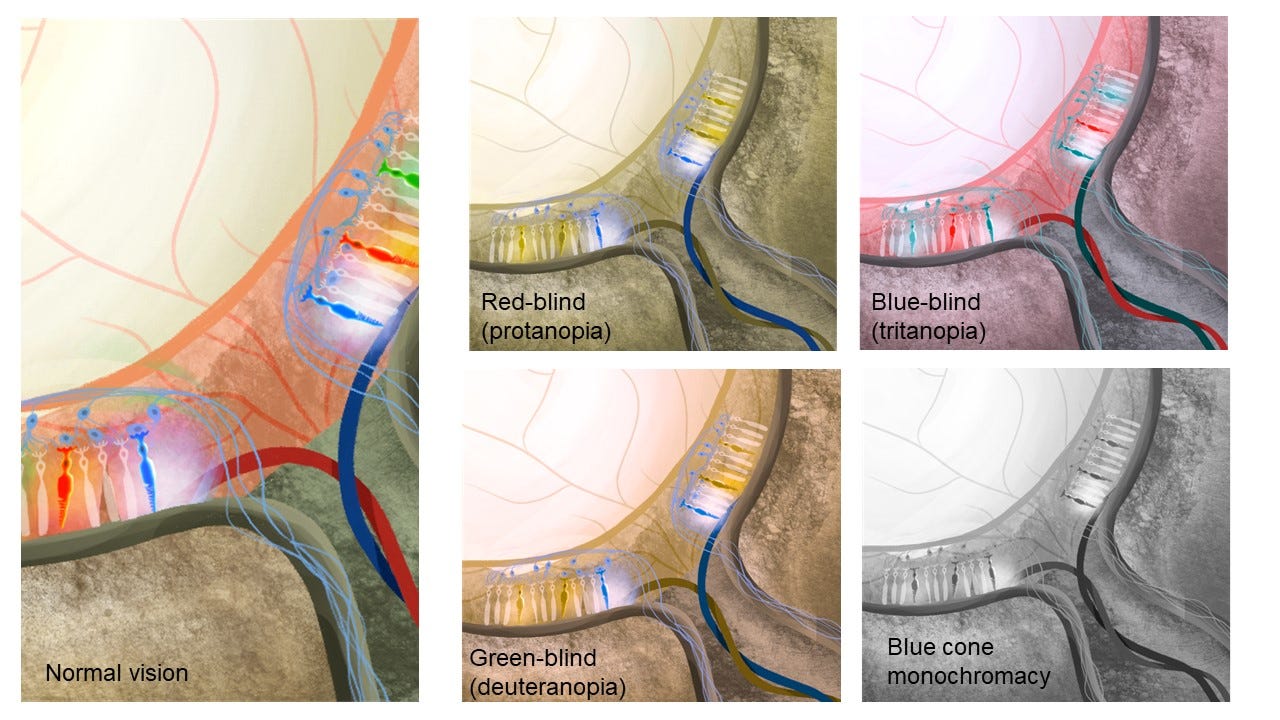
Caption: Normal trichromatic vision relies on three cone types. Small genetic differences in cone sensitivity create individual variations in color perception.
The Brain’s Role: Color Constancy and Assumptions
Your brain doesn’t just passively receive signals from the eyes—it actively constructs color.
One key mechanism is color constancy: the brain tries to maintain stable object colors despite changes in lighting. To do this, the brain makes unconscious assumptions about the illuminant (the light source).
This phenomenon is dramatically illustrated by #TheDress (2015). Some people saw the dress as white and gold; others saw it as blue and black. The actual dress is blue and black, but the photo had ambiguous lighting.
- People who assumed the dress was in shadow (often bluish) subtracted blue light and saw white/gold.
- People who assumed it was under warm artificial light subtracted yellow and saw blue/black.
The same image, different brains, different perceptions.
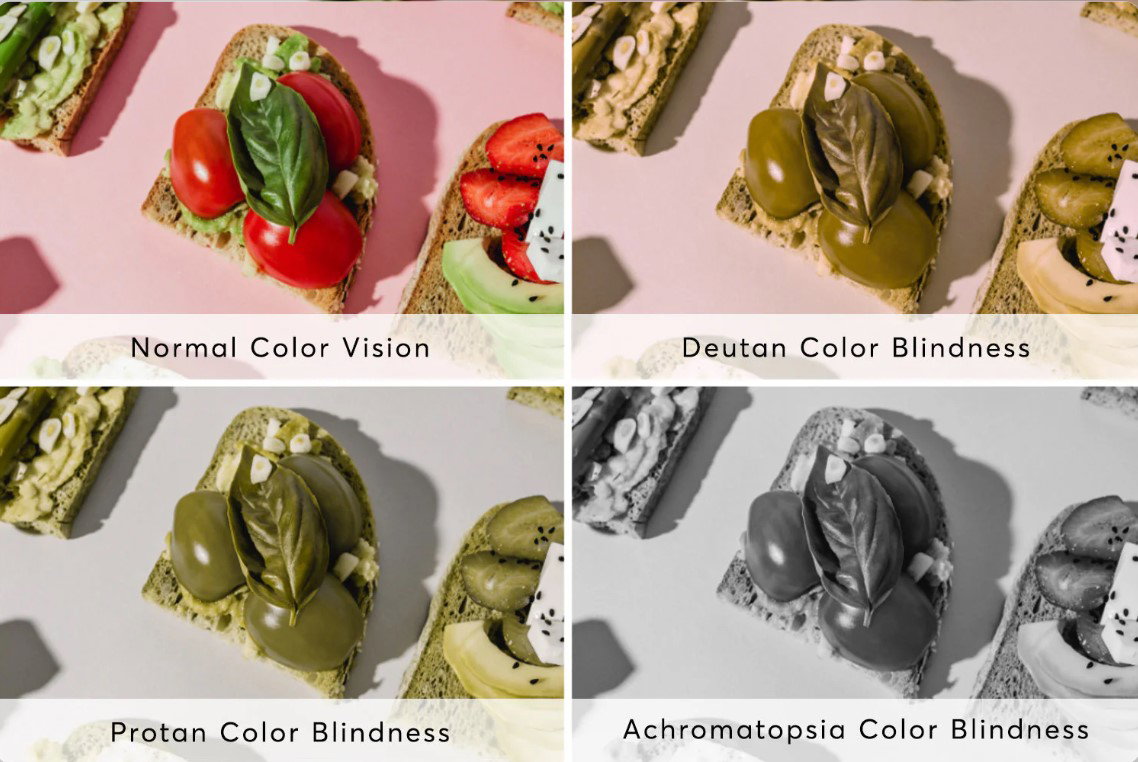
Caption: Classic example of perceptual variation: the same scene can look strikingly different depending on individual assumptions about lighting and color constancy.
Other Factors That Influence Color Perception
- Lighting conditions: Different light sources (daylight vs. LED vs. incandescent) have different spectral distributions, triggering metamerism (colors that match under one light but not another).
- Age: The lens of the eye yellows over time, filtering out more blue light.
- Language and culture: Some studies suggest that the words your language has for colors can subtly influence how you categorize and remember them.
- Health and medications: Certain drugs or conditions can temporarily alter color vision.
- Mood and attention: Psychological state can influence how vividly or accurately colors are perceived.
What This Means for All of Us
The fact that two people can see the same color differently reveals something profound: reality is filtered through biology and brain processing. What feels like an objective world of color is actually a constructed experience unique to each individual.
This understanding drives better design:
- Color-blind-friendly interfaces (avoiding red-green contrasts alone)
- Consistent branding across different screens and lighting
- Inclusive products that account for natural human variation
It also fosters empathy. Next time you disagree with someone about whether something is teal or turquoise, remember—you might both be right.
Color isn’t “out there” in the world. It’s created inside your head—and no two heads create it exactly the same way.