Color Appearance Models: Making Digital Colors Look Real
Your screen can display millions of colors using RGB values. Yet sometimes a photo looks perfect on your phone but washed out on your laptop, or a sunset on your TV appears dull compared to real life.
Why does this happen? This is due to the fact that raw RGB or XYZ values fail to accurately reflect the way humans perceive color in various settings.
That’s where Color Appearance Models (CAMs) come in. These sophisticated models predict not just the physical color but how it appears to the human eye—considering lighting, background, surroundings, and adaptation. They are the reason modern HDR displays, professional monitors, and color-managed workflows look so lifelike.
Beyond Physics: The Problem with Simple Color Spaces
CIE XYZ (1931) and CIELAB (1976) are excellent for measuring color mathematically and ensuring consistency between devices. However, they have a major limitation:
They ignore viewing conditions.
- The same RGB value can look brighter or duller depending on whether you’re in a dark room or bright daylight.
- Colors appear more vivid against a dark background and duller against a bright one.
- Our eyes constantly adapt to the dominant light source (chromatic adaptation), shifting our perception of “white” and all other colors.
Simple color spaces can’t predict these real-world perceptual shifts. Color appearance models solve this by modeling the entire visual experience.
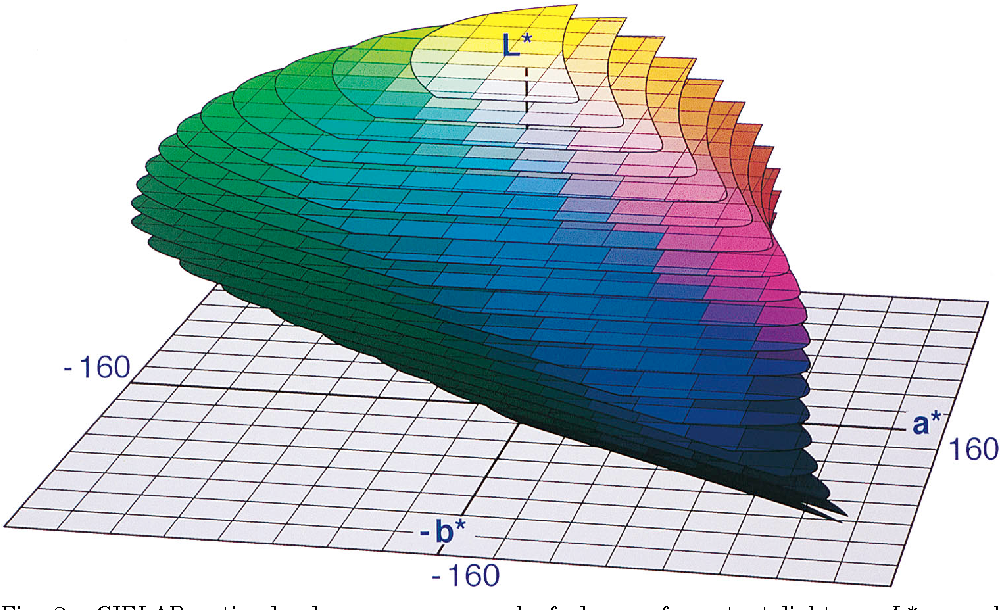
Caption: The CIELAB color space is useful for measurement, but it doesn’t fully account for how colors appear under different lighting and backgrounds—the core problem Color Appearance Models address.
What Are Color Appearance Models?
A color appearance model takes objective color data (usually from CIE XYZ) and predicts perceptual attributes such as
- Lightness (J) — How bright or dark a color appears relative to the surround
- Colorfulness (M) or Chroma (C) — How vivid or saturated the color looks
- Hue (h) — The actual hue angle (red, yellow, green, blue, etc.)
- Brightness (Q) — Absolute perceived brightness
The most widely used models are:
- CIECAM02 (2002) — A major step forward, used in many professional applications
- CIECAM16 (2016) — The current standard, with improved accuracy for HDR and complex viewing conditions
These models incorporate factors like:
- The adapting field (the light your eyes are adjusted to)
- Background and surround luminance
- Degree of chromatic adaptation
- Viewing angle and luminance level
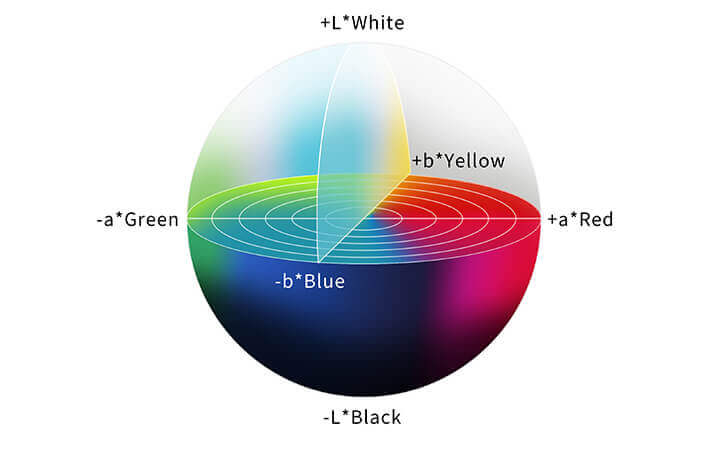
Caption: Simplified representation of perceptual attributes in a Color Appearance Model—lightness, chroma, and hue are predicted based on real viewing conditions.
Why Color Appearance Models Matter Today
Modern displays and content have pushed far beyond traditional sRGB:
- HDR content has extreme brightness ranges (up to 10,000 nits). Without a good CAM, bright highlights can look blown out or dull.
- Wide color gamuts (DCI-P3, Rec.2020) contain more saturated colors than older spaces. CAMs ensure these saturated colors look natural, not artificial.
- Different devices and environments—a phone in bright sunlight vs. a TV in a dark living room—require the model to adapt the image so it “feels” consistent.
Color appearance models are now built into the following:
- Professional color grading software (DaVinci Resolve, Adobe Premiere)
- Operating systems (macOS, Windows HDR)
- Camera raw processing
- High-end TV and monitor firmware
They help maintain color constancy — the feeling that colors remain stable even when lighting changes.
The Future of Color Appearance
As displays become brighter, more dynamic, and more immersive (think micro-LED and future holographic displays), color appearance models will become even more important. Research continues on newer models that better handle complex real-world scenes, spatial effects, and individual differences in vision.
In short, Color Appearance Models are the bridge between the physics of light and the psychology of human perception.
Final Thought
Next time you watch a stunning HDR movie or admire a perfectly rendered photograph on your screen, remember: it’s not just about having more pixels or wider color gamuts.
It’s about sophisticated color science working behind the scenes to make digital colors look real—exactly as your eyes and brain expect them to appear in the real world.
Color appearance models are one of the most elegant achievements in modern color science: they don’t just reproduce color—they reproduce experience.