The Hidden Science Behind Your Screen's Colors (RGB Explained)
Every time you watch a video, scroll through photos, or play a game on your phone, laptop, or TV, you’re experiencing one of the most elegant tricks in modern technology.
Your screen can display millions—even billions—of colors, yet it only uses three: red, green, and blue.
How is that possible? The answer lies in the fascinating science of additive color mixing and the clever way your screen mimics human vision.
The Magic Starts with Your Eyes
Human color vision is based on three types of cone cells in the retina:
- L-cones — most sensitive to long wavelengths (red)
- M-cones — most sensitive to medium wavelengths (green)
- S-cones — most sensitive to short wavelengths (blue)
Your brain doesn’t see “red,” “green,” or “blue” directly. It compares the relative stimulation of these three cone types and constructs the sensation of color from that comparison.
Screens exploit this exact biology.
How Screens Create Color: Additive Mixing
Unlike paint (which uses subtractive mixing and gets darker when you mix colors), screens use additive mixing — they start with black (no light) and add colored light together.
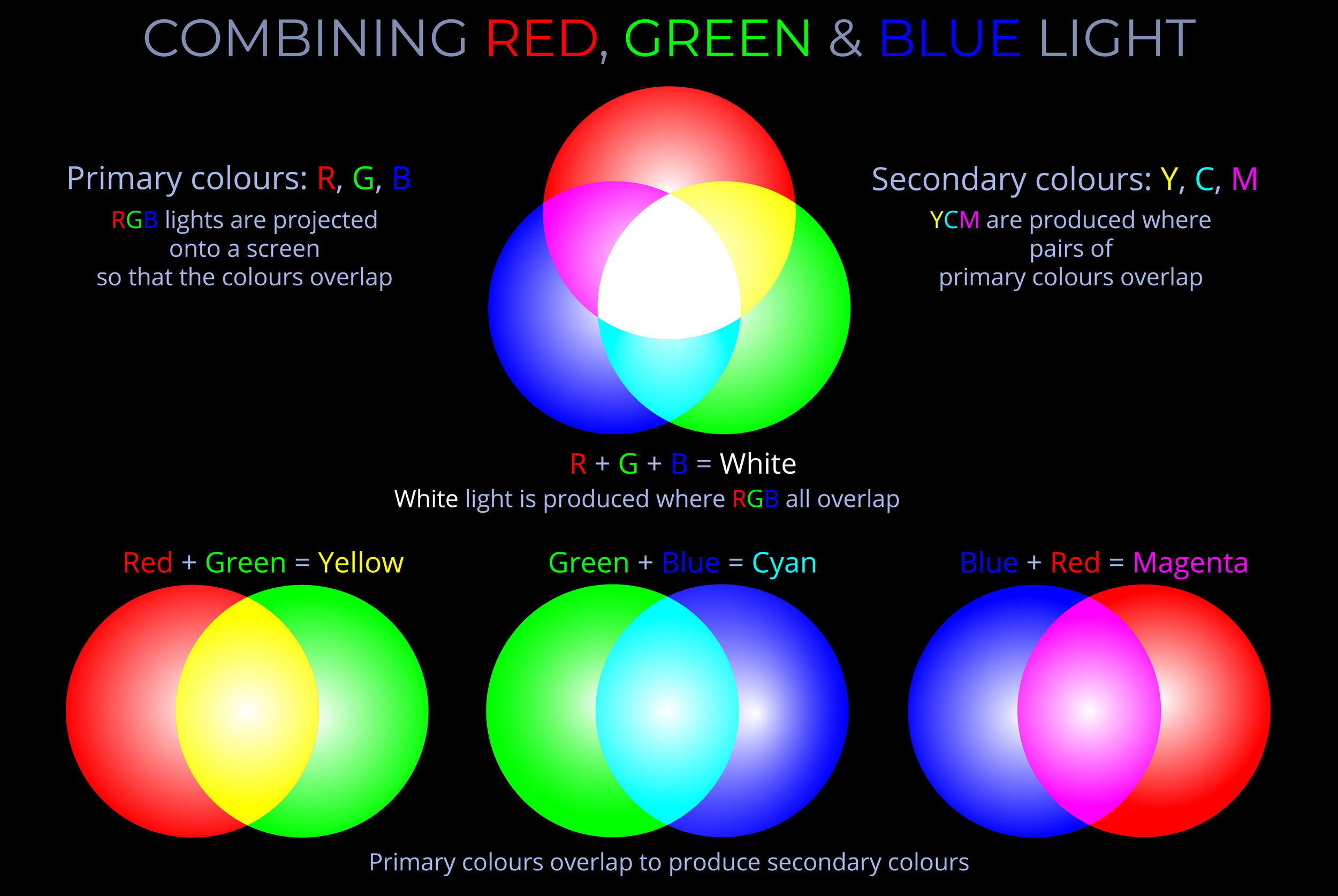
The three primary colors of light are red, green, and blue (RGB). Here’s what happens when you combine them:
- Red + Green = Yellow
- Green + Blue = Cyan
- Blue + Red = Magenta
- Red + Green + Blue (at full intensity) = White
This system allows screens to produce virtually any color the human eye can see by varying the intensity of each primary.
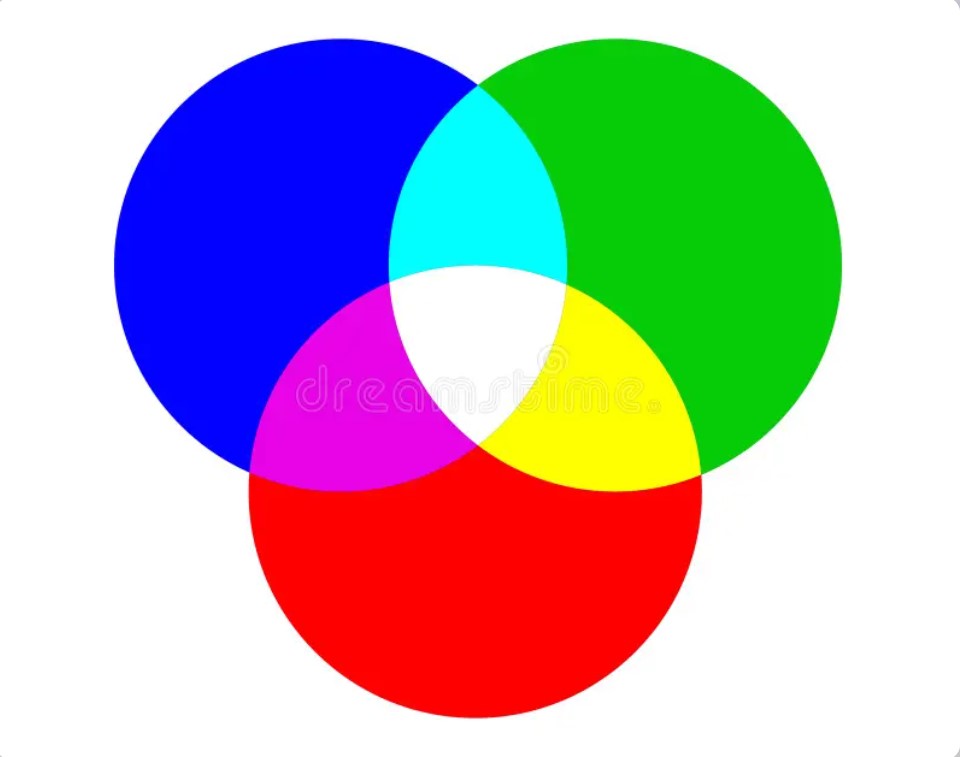
Caption: Additive color mixing in action. Red + Green + Blue light creates white where all three overlap.
The Secret Weapon: Subpixels
Look very closely at your screen (or use a magnifying glass). You’ll see that every pixel is actually made of three tiny subpixels—one red, one green, and one blue.
By controlling how brightly each subpixel glows, the screen can mix light at the pixel level to create any color.
- Want pure red? Turn the red subpixel on fully and green and blue off.
- Want yellow? Turn the red and green lights on fully; turn the blue light off.
- Want a soft pink? Turn red high and green and blue at medium levels.
This subpixel trick is why modern screens can display over 16 million colors in 8-bit mode and over a billion colors in 10-bit or 12-bit HDR displays.
Caption: Close-up view of RGB subpixels on a screen. Each full pixel contains red, green, and blue subpixels.
Why RGB Matches Human Vision Perfectly
The RGB system works so well because it was designed around the trichromatic theory of human vision—the same three-cone system we all have.
Engineers didn’t invent RGB arbitrarily. They reverse-engineered how our eyes and brain perceive color, then built displays to match that biology.
That’s why a simple combination of just three lights can fool your eyes into seeing the full rainbow.
RGB vs Real-World Colors
While RGB covers most colors we see in daily life (the sRGB color space is the standard for web and most devices), it doesn’t cover every color the human eye can perceive. That’s why professional displays use wider gamuts like the following:
- Adobe RGB
- DCI-P3 (used in cinemas and high-end phones)
- Rec.2020 (for future 8K and HDR content)
These wider spaces still rely on the same RGB foundation but allow more saturated greens, reds, and blues.
Why This Science Matters
Understanding RGB helps you:
- Choose the right color settings on your devices
- Calibrate your monitor for accurate photo editing
- Design graphics that look consistent across different screens
- Appreciate why printed colors often look different (they use subtractive CMYK mixing)
Next time you admire a stunning sunset on your phone or watch a vibrant movie on TV, remember: you’re not just seeing pixels—you're seeing millions of precisely controlled red, green, and blue lights working together to recreate the world inside your eyes.
The hidden science of RGB is one of the most beautiful examples of technology working in perfect harmony with human biology.