How Color Science Powers Modern Digital Displays and Printing
Every vibrant image on your phone, the lifelike colors in a movie on your TV, and the sharp photo you just printed—all of it is made possible by centuries of color science.
Behind the scenes, sophisticated models, precise measurements, and clever engineering translate the physics of light into the colors we see. At the heart of it all are two fundamental approaches: additive color for digital displays and subtractive color for printing, unified by universal standards like CIE color spaces and ICC profiles.
The Foundation: How Humans See Color
Color isn’t a property of objects—it's how our eyes and brain interpret different wavelengths of light. Our retinas have three types of cone cells sensitive to short (blue), medium (green), and long (red) wavelengths. The brain compares their signals to create the perception of millions of colors.
Modern technology exploits this trichromatic vision to recreate color efficiently.
Additive Color: The Science Behind Digital Displays
Digital screens (LCD, OLED, QLED, and micro-LED) use additive color mixing. They start with darkness (black) and add red, green, and blue (RGB) light to build brighter colors.
- How it works: Each pixel contains tiny red, green, and blue subpixels. By varying the intensity of each, the screen mixes light directly. Red + Green = Yellow; all three at full power = White.
- Why RGB? It closely matches the three cone types in our eyes, allowing efficient reproduction of a wide gamut of colors.
- Modern advancements:
- OLED: Self-emissive pixels turn on/off individually for perfect blacks and high contrast. Each pixel emits its own RGB light.
- LCD/LED: Use a backlight (often white LED) filtered through RGB subpixels or quantum dots for enhanced brightness and wider color gamuts (e.g., DCI-P3 or Rec.2020).
- Quantum Dots: Convert blue light into purer red and green for more saturated, accurate colors with less energy loss.
Color science ensures consistency through standards like sRGB (for web and most devices) and wider gamuts for professional or HDR content. Calibration and color management keep what you see on screen accurate across devices.
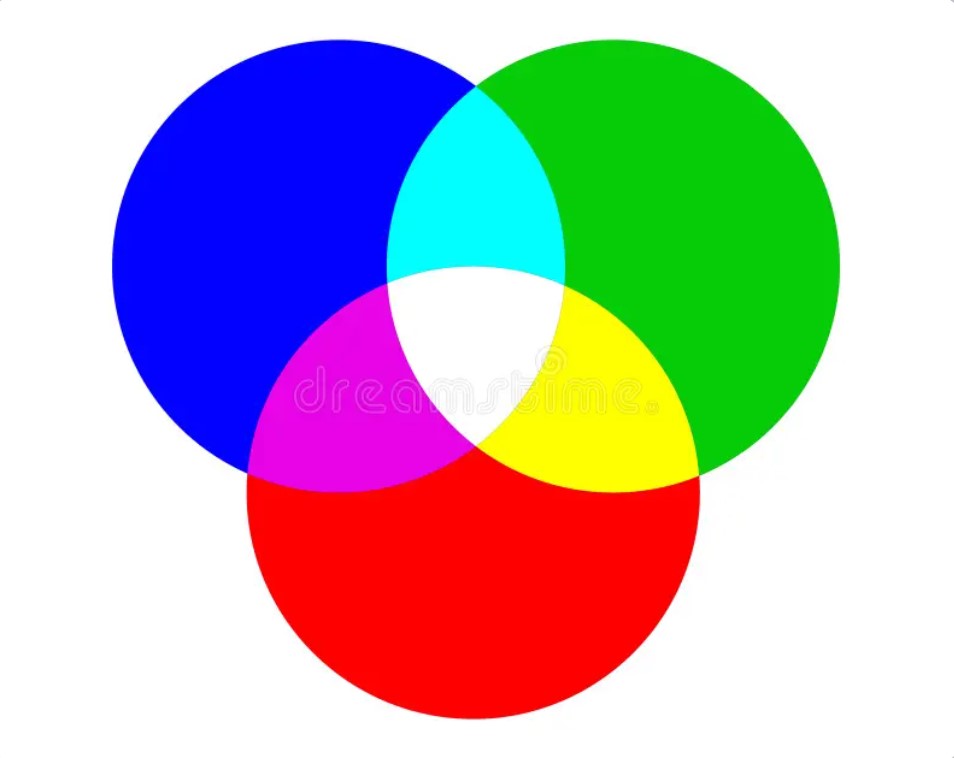
Caption: Additive RGB mixing — the foundation of every digital display.
Subtractive Color: The Science Behind Printing
Printing uses subtractive color mixing. It starts with white paper (which reflects all light) and adds inks that absorb (subtract) specific wavelengths.
- Primary inks: Cyan, Magenta, Yellow, and Black (CMYK). Black (K) is added for deeper shadows and to save colored ink.
- How it works: Ink absorbs certain colors in white light. For example, cyan ink absorbs red, reflecting blue and green. Layering inks controls what light is reflected back to your eyes.
- Challenges: Real inks aren’t perfect, so printers rely on precise formulations and multiple passes for rich colors.
Printing demands high accuracy because once ink is on paper, you can’t easily adjust it.
Bridging Displays and Printing: Color Management
Displays and printers speak different “languages” (additive RGB vs. subtractive CMYK), so color science provides translators:
- CIE Color Spaces (XYZ, LAB): Device-independent mathematical models based on human vision. They serve as a universal reference.
- ICC Profiles: Files that describe how a specific device (screen, printer, camera) reproduces color. They enable accurate conversion between RGB and CMYK using a profile connection space (usually based on CIE LAB or XYZ).
- Color Management Systems: Software (in Photoshop, your OS, or printer drivers) uses these profiles to ensure “what you see on screen is what you get in print.”
Without color management, the same image would look wildly different across devices.
Why This Matters Today
- Displays: Wider color gamuts (Quantum Dots, OLED) and HDR bring cinema-like realism to consumer devices.
- Printing: High-CRI lighting, better inks, and advanced profiling deliver photo-quality output on inkjets and presses.
- Everyday Impact: Better product photos online, consistent brand colors, accurate medical imaging, and vibrant art reproductions.
Color science turns raw light and pigments into reliable, beautiful experiences across mediums.
Next time you admire a stunning photo on your phone or hold a vivid print in your hands, remember: it’s not magic—it's decades of precise color science at work, carefully engineered to match the way your eyes see the world.